Hello Agents!!
Some quick thoughts on agentic ai and how the software ecosystem is changing with it.
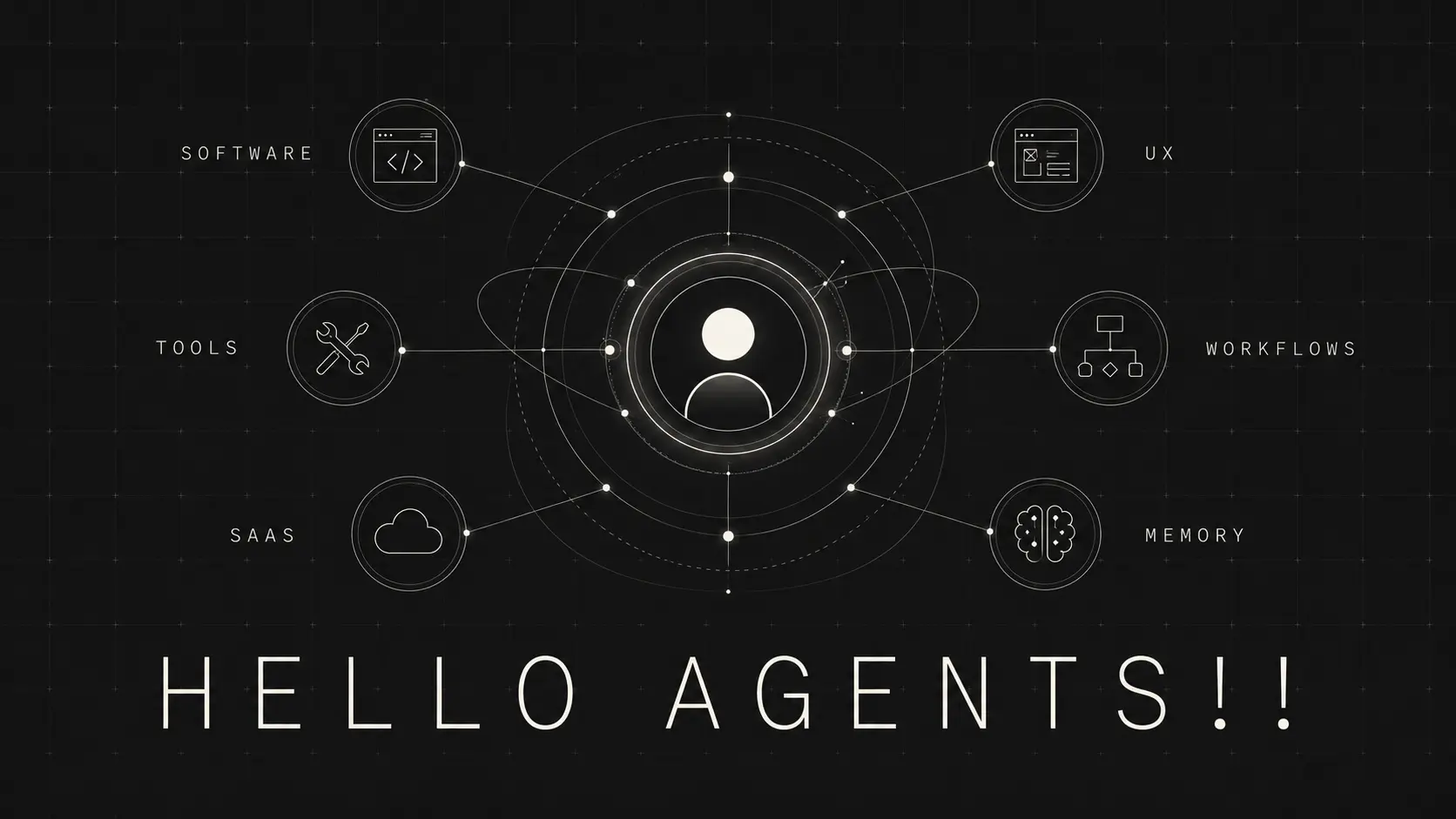
Software has always been built around instructions. You click a button, fill in a form, choose an option, and the system follows a path that someone designed in advance. Even the most sophisticated products have largely worked this way. They wait for the user to tell them what to do, one step at a time.
Agents introduce a different idea.
Instead of asking the user to control every step, an agent can be given a goal and allowed to work out parts of the process on its own. It can interpret the request, decide what information it needs, use available tools, take an action, examine the result, and continue until it reaches an outcome or needs human input.
This may sound like a small change in how software works, but it is not. It changes what software is expected to do, how people interact with it, and how software companies create and sell value.
It also explains why the word “agent” currently means different things to different people. A business leader may use it to describe any AI system that completes a task, while an engineer may be thinking about models, tools, memory, permissions, state, and execution loops. Both may be discussing the same product, but they are often picturing very different systems.
Before we can understand where agents may take software, it helps to be clear about what they actually are.
What Are Agents, Really?
The simplest useful definition is this:
An agent is a software system that can understand a goal, decide what actions to take, use tools, and work toward an outcome.
The model is the part that interprets the task and makes decisions, but the model alone is not the agent. An agent also needs an environment in which it can operate, access to the right information, and tools that allow it to do something beyond generating text.
For example, a model may be able to explain how to reschedule a meeting, but an agent could check the calendar, identify available time slots, update the event, and notify the people involved. The difference is not simply that one system sounds smarter. The difference is that one can take action.
A practical agent usually includes a few important components. It has a model that helps it reason about the task, context that tells it what is happening, some form of memory or state that helps it track progress, and tools that allow it to interact with software, data, or external systems. It also runs inside a controlled environment that manages permissions, failures, retries, and other operational details.
This distinction matters because the word is currently used too loosely.
A chatbot is not automatically an agent. A chatbot may answer questions without taking any action. A fixed automation is not automatically an agent either, because it may simply follow a predefined sequence without making decisions. Adding a language model to an existing product does not automatically make the product agentic.
The useful question is not whether a product contains AI. The useful question is whether the system can decide what to do next and act on that decision within clearly defined boundaries.
This is also where technical and non-technical definitions begin to separate. A business leader may look at the outcome and say, “The agent completed the work.” A technical team must look underneath that outcome and ask how the system made its decision, which tools it used, what information it accessed, what could go wrong, and when it should stop.
The business definition focuses on completed work. The technical definition focuses on controlled execution. A successful product needs both.
How Agents Change Software
Traditional software is built around features and workflows. A product team decides what users may want to do, then creates screens, buttons, forms, and rules that guide them through those actions.
This model works well when the task is predictable. If someone wants to submit an expense claim, the software can provide a form with fixed fields and a clear approval flow. If someone wants to create an invoice, the product can guide them through a known set of steps.
The difficulty begins when the real task does not fit neatly into the workflow.
Users rarely think in terms of product features. They think in terms of outcomes. They do not wake up wanting to update seven fields in a customer relationship management system. They want to understand which customers need attention. They do not want to navigate a reporting dashboard. They want to know why revenue changed and what should be done next.
Agents allow software to move closer to this way of thinking.
Instead of forcing a user to translate an outcome into a series of product operations, the system can begin doing some of that translation itself. The user provides the goal, while the agent determines which tools, information, and actions may be required.
This changes software from a collection of capabilities into a system that can coordinate capabilities.
A traditional product may contain search, reporting, messaging, and task management as separate features. An agent can use all four in sequence to complete a larger job. It may search for information, compare the results, prepare a summary, send a message, and create a follow-up task without requiring the user to move between multiple screens.
The software is no longer only answering the question, “What can the user do with this product?” It is also answering, “What can this product do for the user?”
That creates new possibilities, but it also introduces new responsibilities. When software begins making decisions, product teams must think carefully about permissions, visibility, accuracy, and control. A wrong recommendation is inconvenient. A wrong action may be costly.
For this reason, the future of agentic software will not depend only on how capable the models become. It will depend on how well the surrounding systems manage those capabilities.
How Agents Change User Experience
Most software requires users to learn the logic of the product before they can get value from it. They must understand where information lives, which menu contains the right option, what sequence of steps is expected, and how the system represents their work.
Over time, experienced users become good at operating the software, but that does not necessarily mean the software is good at understanding the user.
Agents may reverse part of this relationship.
Instead of asking people to learn every workflow, software can begin interpreting what they are trying to achieve. The user may describe the goal in familiar language, while the system handles the operational details in the background.
This does not mean every product will become a chat window. Chat is useful because language is flexible, but typing instructions into a box is not the final form of agentic user experience. In many cases, the agent may work through existing interfaces, appear inside familiar workflows, or act quietly until it needs a decision.
The more important change is that the interface becomes less focused on navigation and more focused on intention, progress, and control.
Users will need to know what the agent understood, what it plans to do, which actions it has already taken, and where human approval is required. A useful agent should not feel like a mysterious box moving through a company’s systems. It should make its work understandable.
This creates a new set of user experience questions.
How does the user express a goal clearly? How does the system show uncertainty? When should it ask a question instead of making an assumption? How can the user correct it halfway through a task? How much detail should it show without turning every action into a flood of notifications?
These questions are different from designing a better button or a simpler menu, because the interface is no longer only helping the user operate the software. It is helping the user supervise a system that can operate parts of the software on their behalf.
Trust becomes part of the interface.
A product may have excellent reasoning capabilities, but users will avoid it if they cannot understand what it is doing. On the other hand, an agent that communicates clearly, asks for approval at the right moments, and makes its actions easy to review may feel useful even before it becomes fully autonomous.
The best agentic experiences may not be the ones that remove the human from the process. They may be the ones that involve the human more intelligently.
How Agents Change SaaS
Software as a service has traditionally been organised around access to features. A company pays for a product because it provides tools for sales, finance, support, marketing, operations, or another business function.
The value is usually tied to what users can do inside the software.
Agents begin shifting that value toward what the software can complete.
A sales platform may no longer be judged only by how well it stores customer information. It may be expected to research an account, identify relevant signals, prepare outreach, update records, and recommend the next action. A support platform may move beyond organising tickets and begin investigating common issues, applying approved fixes, and closing routine cases.
This moves SaaS from providing tools toward delivering outcomes.
That shift could change how products are designed. Instead of building isolated features, teams may build capabilities that an agent can combine. Search, analytics, messaging, permissions, and workflow tools become parts of a larger execution system rather than separate destinations in the interface.
It may also change how software is priced. Charging by seat makes sense when value is closely tied to the number of people actively using a product. It becomes less obvious when an agent is completing work across several systems without constant human interaction.
Companies may begin pricing around usage, completed tasks, business outcomes, or some combination of these. None of these models will be simple, because customers will still need predictability while vendors will need to account for the real cost of running agentic systems.
The product relationship may change as well.
Traditional SaaS onboarding teaches users how to operate the product. Agentic onboarding may require the company to teach the system how the organisation works. The agent may need access to business rules, internal language, approval policies, data sources, and examples of good decisions.
This makes context a central part of the product.
Two companies may use the same agent but receive very different results because their information, processes, and expectations are different. The model matters, but the organisation’s context may become the real source of differentiation.
For SaaS companies, this creates both an opportunity and a difficult product challenge. It is easier to demonstrate an agent completing a task than it is to make that behaviour reliable across thousands of customers with different systems, rules, and risk levels.
The winners may not be the companies with the most impressive demonstrations. They may be the ones that make agents dependable inside ordinary, messy business environments.
What the Future May Look Like
The future of software may not be a world where agents replace every application or complete every task without human involvement.
A more realistic future is one where agents become a new operating layer across software.
Applications may still exist, but users may spend less time moving between them. Instead of opening several products and coordinating the work manually, a user may describe the outcome, review the proposed plan, approve sensitive actions, and step in when judgment is required.
Software may gradually move into the background, while goals, decisions, and results move to the foreground.
This will not happen all at once. Some tasks are structured enough for agents to handle with limited supervision, while others involve ambiguity, risk, or human responsibility that cannot be delegated so easily. Companies will learn through a long period of partial automation, careful permissions, and frequent handoffs between people and systems.
The most valuable agents may not be the ones that claim complete autonomy. They may be the ones that understand their boundaries.
They will know when they have enough information to act, when they need to ask a question, when an approval is required, and when the task should return to a human. That kind of judgment may matter more than performing an impressive chain of actions in a controlled demonstration.
Agents represent a change in what we expect from software. We are moving from systems that wait for instructions toward systems that can participate in the work.
For users, this may mean less time operating software. For builders, it means designing behaviour instead of only designing features. For SaaS companies, it means selling completed work rather than access to tools.
And for the software industry as a whole, it may mark the beginning of a future where software is no longer defined only by what it allows us to do, but by what we can safely allow it to do for us.